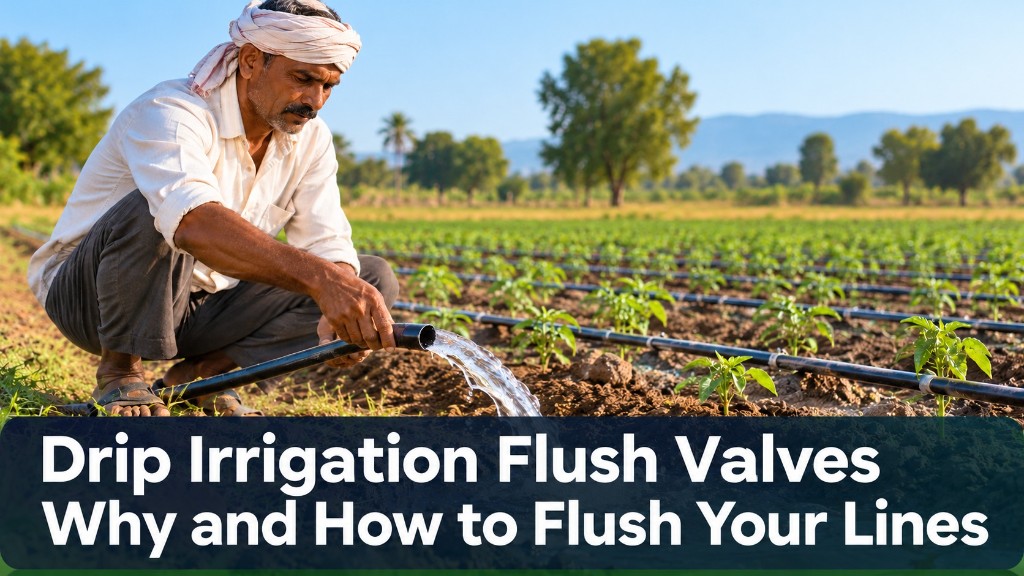
Learn how flush valves help remove accumulated debris from drip lines and how to plan safe, effective flushing.
Why drip lines need flushing
Sediment, organic material and deposits can collect in irrigation pipes and laterals. If not managed, particles may contribute to blocked emitters and uneven water delivery. A flush point provides a controlled way to discharge water and carry loose debris from a line. Flushing complements suitable filtration, water treatment and maintenance; it does not replace them.
Where to place flush points
Installers commonly provide accessible flushing arrangements at the ends of relevant lines or sections. The correct position, connection and size depend on the layout and flow needed for effective flushing. Make sure discharged water can drain to a safe location without erosion or damage to crops, paths or equipment.
A practical flushing routine
Follow the irrigation designer’s or equipment manufacturer’s procedure. Check the filter first, then flush individual sections in a controlled sequence so available flow is sufficient. Open and close the flush point as instructed, and continue until the discharge runs acceptably clear. Frequency depends on the water source and observed debris; a fixed interval is not right for every farm.
What a flush valve cannot fix
If emitters remain blocked after flushing, the cause may include fine particles, biological growth or chemical deposits. Identify the cause before using any cleaning chemical. Check compatibility of the entire system and follow product and safety instructions. Do not mix chemicals or apply an unapproved treatment based only on a general article.
Buying and installation checklist
Confirm lateral or pipe size, connection dimensions, expected pressure, water quality and accessibility. FLOTEC lists flush valves as part of its irrigation range. Review https://flotecvalve.com/products and ask for the model suitable for your line.
Frequently asked questions
How often should lines be flushed? Base the schedule on water quality, filter performance and field observations with your installer.
Is a flush valve the same as a filter? No. A filter removes contaminants upstream; a flush point helps discharge material from the line.