
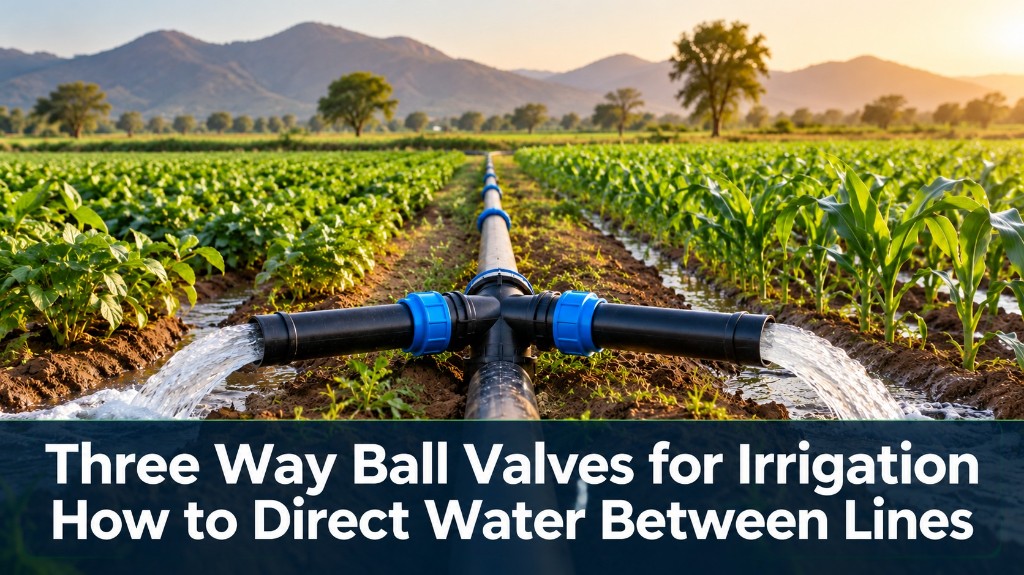
Understand three way ball valve flow paths and the key checks for diverting water in irrigation systems.
A valve with more than one flow path
A three way ball valve can be used to route flow between connected lines, depending on its internal port arrangement. It may simplify certain layouts where an operator needs to select between two paths. The exact function depends on the valve’s port configuration and handle position, so review the manufacturer’s flow diagram before choosing it.
Understand L port and T port
Three way valves may use different internal passages, often described as L port or T port. These names describe the shape of the passage, but do not by themselves guarantee a particular shut-off or switching sequence. Some designs connect more than two ports in certain positions. Ask for a diagram for every handle position and confirm whether an all-ports-closed position is available if your system requires one.
Match the system to the valve
Check the pipe size, port sizes, connection type, maximum pressure and temperature. Confirm compatibility with water and any injected fertiliser, including the seals. Consider pressure changes when switching paths and make sure the receiving line can safely handle the flow. A system designer should determine whether the arrangement is suitable for the pump and control scheme.
Plan for clear field operation
Install the valve in an accessible position and label the connected lines and approved handle positions. This reduces the chance of sending water to the wrong zone. Support pipework to avoid stress on the body, and follow installation and inspection instructions for the selected model.
Ask before placing an order
Share a simple sketch showing the inlet, both outlets and the intended switching sequence. FLOTEC’s website shows a three way valve in its product family; confirm current availability, port arrangement, size and rating at https://flotecvalve.com/products.
Frequently asked questions
Can every three way valve completely stop flow? No. It depends on the design and handle positions.
Can it replace two separate isolation valves? Sometimes, but the required isolation and safety arrangement must be checked for the specific system.